
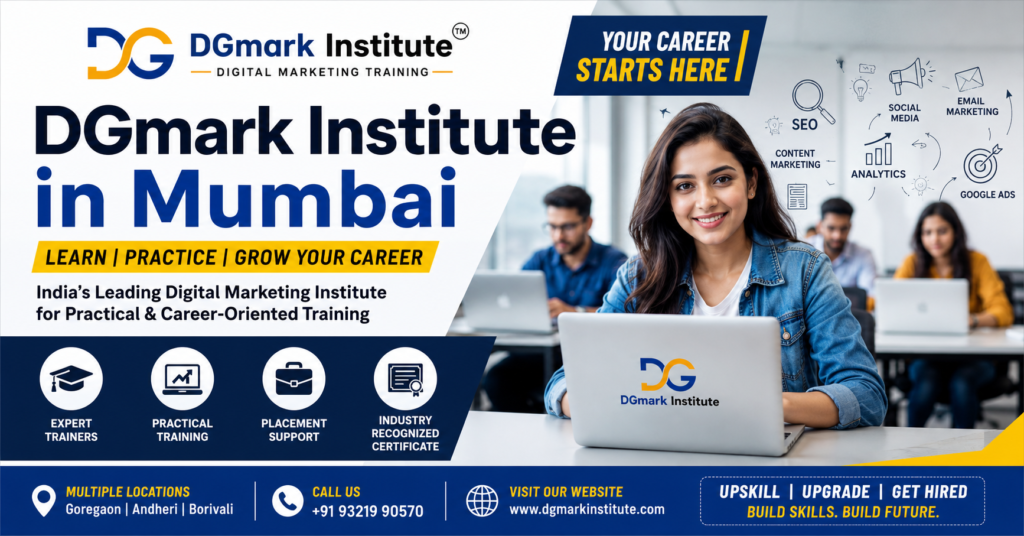
Digital marketing has become one of the fastest-growing career options in India. From startups and local businesses to multinational corporations, every organization needs skilled professionals who can help them build a strong online presence, generate leads, and increase sales. As businesses continue to shift towards digital platforms, the demand for trained digital marketers is increasing rapidly.
However, learning digital marketing from the right institute plays a crucial role in shaping your career. A well-structured course, practical exposure, industry-relevant curriculum, and expert mentorship can significantly improve your chances of landing a rewarding job or starting a successful freelance or entrepreneurial journey.
If you’re searching for a trusted DGmark Institute in Mumbai, this comprehensive guide will help you understand everything you need to know. From the institute’s vision and teaching methodology to its founder, locations, curriculum, placement support, and student-focused approach, this article covers every important aspect to help you make an informed decision.
Whether you are a student, graduate, working professional, freelancer, entrepreneur, or business owner, this guide will explain why DGmark Institute in Mumbai has become a preferred destination for practical digital marketing education.
About DGmark Institute in Mumbai
Choosing the right institute is the first step toward building a successful digital marketing career. While many institutes offer digital marketing courses, only a few focus on practical implementation, real business experience, and industry readiness.
DGmark Institute in Mumbai was established with the objective of bridging the gap between theoretical education and practical digital marketing skills. The institute focuses on helping students gain hands-on experience rather than simply learning concepts from presentations or textbooks.
The curriculum is designed to prepare learners for real-world challenges by combining classroom learning with live projects, assignments, workshops, portfolio development, and career guidance.
Today, DGmark Institute in Mumbai has earned recognition among aspiring digital marketers because of its practical training methodology and industry-oriented curriculum.
Some of the core principles that define the institute include:
- Practical-first learning approach
- Industry-relevant curriculum
- Live project implementation
- Small batch sizes for personalized attention
- Experienced trainers
- Career-focused education
- Continuous syllabus updates
- AI-integrated digital marketing learning
These principles help students develop confidence and acquire job-ready skills before completing their course.
Vision of DGmark Institute
The vision of DGmark Institute in Mumbai is to create skilled digital marketing professionals who can confidently work in agencies, startups, corporate companies, or build their own successful businesses.
Instead of producing certificate holders, the institute aims to develop professionals who understand digital marketing from a strategic and practical perspective.
The institute believes that education should focus on solving real business problems rather than memorizing theoretical concepts.
Mission of DGmark Institute
The mission of DGmark Institute in Mumbai is centered around providing quality digital marketing education that is practical, affordable, and career-oriented.
Its mission includes:
- Making digital marketing education accessible.
- Teaching industry-relevant skills.
- Preparing students for employment.
- Encouraging entrepreneurship.
- Building confident freelancers.
- Helping businesses grow digitally.
- Promoting continuous learning.
Why DGmark Institute is Different
Thousands of students enroll in digital marketing courses every year, but employers often look for candidates who have practical experience rather than just certifications.
This is where DGmark Institute in Mumbai differentiates itself.
Instead of relying heavily on classroom lectures, the institute focuses on experiential learning through:
Practical Learning
Students work on assignments that simulate real marketing campaigns, allowing them to apply concepts immediately.
Live Projects
Working on live projects enables learners to understand client requirements, campaign execution, performance analysis, and optimization techniques.
Updated Curriculum
Digital marketing evolves rapidly. The institute regularly updates its syllabus to include the latest trends, platforms, AI tools, and marketing strategies.
Industry Exposure
Students gain insights into how digital marketing functions in real businesses, helping them understand practical workflows and expectations.
Career-Oriented Training
The emphasis is on making students employable by developing both technical and soft skills, including communication, interview preparation, and resume building.
Founder of DGmark Institute
One of the strongest pillars behind the success of DGmark Institute in Mumbai is its founder, Digital Chandan Thakur.
Chandan Thakur is a digital marketing professional and educator who established the institute with the goal of making high-quality, practical digital marketing education accessible to students and professionals. Drawing on his experience in the digital marketing industry, he recognized that many learners completed courses with theoretical knowledge but limited hands-on exposure. This insight shaped the institute’s emphasis on practical training, live projects, and industry-ready skills.
Rather than creating another classroom-based training center, his vision focused on developing professionals capable of executing real digital marketing campaigns, understanding business objectives, and adapting to the constantly evolving digital landscape.
Under his leadership, the institute has emphasized:
- Practical implementation over theory
- Continuous curriculum updates
- Industry-relevant teaching
- Student mentorship
- Career-focused education
- Ethical digital marketing practices
This approach has helped position DGmark Institute in Mumbai as a learning environment that prioritizes skills employers value.
The Vision Behind Starting DGmark Institute
The digital marketing industry has grown rapidly over the past decade. As demand increased, many training institutes entered the market. However, a common challenge was that many courses remained heavily theory-based, leaving students underprepared for real-world work.
Recognizing this gap, the founder envisioned an institute where learners could gain hands-on experience, build confidence, and understand how digital marketing is applied in actual business scenarios.
The institute was founded with the objective of creating an ecosystem where students would:
- Learn by doing.
- Build portfolios.
- Work on practical assignments.
- Understand campaign execution.
- Develop analytical thinking.
- Become career-ready professionals.
Core Values of DGmark Institute
The culture at DGmark Institute in Mumbai is built around several key values:
Student-Centric Learning
Training is designed to support students at different stages of their careers, from beginners to professionals looking to upskill.
Practical Knowledge
The curriculum emphasizes actionable skills that can be applied immediately in workplaces or businesses.
Continuous Improvement
As digital marketing platforms evolve, the institute regularly updates its content to reflect current industry practices.
Transparency
Providing clear guidance about courses, learning outcomes, and career support helps students make informed decisions.
Lifelong Learning
Digital marketing is a continuously changing field. Students are encouraged to keep learning beyond the classroom through experimentation, certifications, and industry updates.
Why Students Choose DGmark Institute in Mumbai
When selecting a digital marketing institute, students often look beyond the syllabus. They seek an environment that supports practical learning, mentorship, and career development.
Some of the reasons learners consider DGmark Institute in Mumbai include:
- Practical-focused curriculum
- Experienced mentors
- Hands-on assignments
- Exposure to live projects
- Career guidance
- Resume-building assistance
- Mock interview sessions
- Updated learning resources
- AI tool integration
- Portfolio development
- Supportive learning environment
These features are intended to help learners develop the confidence and experience needed to pursue opportunities in digital marketing.
What Makes DGmark Institute Relevant in 2026?
The digital marketing landscape is evolving rapidly with the rise of artificial intelligence, automation, data analytics, voice search, and personalized marketing. Modern employers increasingly value professionals who can use these technologies effectively.
To stay aligned with industry changes, DGmark Institute in Mumbai emphasizes learning that reflects current trends, helping students build skills relevant to today’s digital marketing environment rather than relying solely on outdated practices.
Digital Marketing Courses Offered at DGmark Institute in Mumbai
One of the strengths of DGmark Institute in Mumbai is its focus on practical, industry-oriented education. Instead of teaching isolated concepts, the institute structures its programs to help learners understand how different digital marketing channels work together to achieve business goals.
The courses are designed for learners with different experience levels—from complete beginners to professionals seeking to upgrade their skills.
Typical learners include:
- Students
- Fresh graduates
- Working professionals
- Freelancers
- Entrepreneurs
- Small business owners
- Marketing executives
- Sales professionals
- Agency owners
The objective is not only to teach tools but also to help learners develop a strategic mindset for planning, executing, and optimizing digital marketing campaigns.
What Students Learn During the Course
Digital marketing is much more than running advertisements or posting on social media. It combines strategy, creativity, analytics, communication, technology, and customer psychology.
A well-rounded digital marketing course should help learners understand:
- How search engines rank websites
- How businesses generate online leads
- How brands build trust through content
- How paid advertising works
- How data helps improve marketing decisions
- How automation improves productivity
- How AI supports digital marketing workflows
At DGmark Institute in Mumbai, the curriculum is structured to provide exposure to these core areas through practical implementation.
Complete Digital Marketing Course Syllabus
A comprehensive digital marketing course typically covers multiple interconnected modules. Below is an overview of the key topics learners can expect to study.
Module 1: Introduction to Digital Marketing
Students begin by understanding:
- What digital marketing is
- Traditional vs digital marketing
- Digital marketing ecosystem
- Customer journey
- Marketing funnel
- Consumer behavior
- Digital marketing channels
- Business applications
This module builds the foundation for the rest of the course.
Module 2: Website Planning
Every digital marketer should understand how websites support online business goals.
Topics include:
- Domain names
- Web hosting
- Website structure
- Landing pages
- User experience (UX)
- Website navigation
- Mobile responsiveness
- Conversion-focused layouts
Students learn why a website is often the central asset of a digital marketing strategy.
Module 3: WordPress Website Development
WordPress powers a significant portion of websites globally, making it an essential skill for digital marketers.
Topics include:
- Installing WordPress
- Dashboard overview
- Themes
- Plugins
- Website customization
- Page builders
- Blog creation
- Contact forms
- Speed optimization
- Security basics
By the end of this module, students can build and manage a functional website without requiring advanced coding skills.
Module 4: Search Engine Optimization (SEO)
SEO is a long-term strategy that helps websites gain visibility in search engine results.
Students typically learn:
- Keyword research
- Search intent
- On-page SEO
- Technical SEO
- Off-page SEO
- Local SEO
- Image optimization
- Internal linking
- Link building
- Google Search Console
- SEO audits
- Content optimization
- Core Web Vitals
- Schema markup fundamentals
Practical exercises may involve optimizing webpages for target keywords and analyzing website performance.
Module 5: Local SEO
For businesses targeting local customers, local SEO is essential.
Topics include:
- Google Business Profile optimization
- Local citations
- Reviews management
- Local keyword targeting
- Maps ranking
- NAP consistency
- Location pages
This module is particularly useful for entrepreneurs and local business owners.
Module 6: Content Marketing
High-quality content supports SEO, social media, email marketing, and lead generation.
Students learn:
- Content strategy
- Blog writing
- Content calendars
- Pillar pages
- Topic clusters
- Copywriting basics
- Storytelling
- Calls-to-action (CTAs)
- Content repurposing
The emphasis is on creating content that educates users while supporting business objectives.
Module 7: Social Media Marketing
Businesses use social media to engage audiences, build communities, and generate leads.
Key topics include:
- Facebook marketing
- Instagram marketing
- LinkedIn marketing
- YouTube marketing
- Content planning
- Organic growth strategies
- Audience engagement
- Social media analytics
- Brand positioning
Students often create sample content calendars and campaign ideas as part of practical assignments.
Module 8: Meta Ads
Paid advertising on Meta platforms enables businesses to reach highly targeted audiences.
Students explore:
- Campaign objectives
- Audience targeting
- Budget planning
- Ad creatives
- Lead generation campaigns
- Conversion campaigns
- Pixel fundamentals
- Performance tracking
- Campaign optimization
The focus is on understanding campaign structure and optimization techniques.
Module 9: Google Ads
Google Ads helps businesses reach users actively searching for products or services.
Topics include:
- Search campaigns
- Display campaigns
- Video campaigns
- Shopping campaigns (overview)
- Keyword match types
- Ad copywriting
- Bidding strategies
- Quality Score
- Conversion tracking
- Performance optimization
Students learn how paid search complements SEO in a comprehensive marketing strategy.
Module 10: Email Marketing
Email remains an effective channel for nurturing leads and retaining customers.
Topics covered include:
- Email strategy
- List building
- Segmentation
- Automation basics
- Newsletter creation
- Campaign analysis
- Subject line optimization
- Personalization
Students learn how email marketing fits into a broader customer lifecycle.
Module 11: YouTube Marketing
Video content continues to play an important role in digital marketing.
Students explore:
- Channel optimization
- Video SEO
- Thumbnail design
- Audience retention
- Playlist strategy
- Analytics
- Video content planning
Module 12: Analytics & Performance Measurement
Data-driven decision-making is essential for marketers.
Key concepts include:
- Google Analytics 4 (GA4)
- Event tracking
- User behavior analysis
- Traffic sources
- Conversion measurement
- Campaign reporting
- Dashboard interpretation
Students learn to evaluate marketing performance using measurable insights.
Module 13: Google Tag Manager (GTM)
Tracking user actions accurately is important for campaign optimization.
Topics include:
- GTM basics
- Tags
- Triggers
- Variables
- Event tracking
- Form tracking
- Pixel implementation (conceptual overview)
Module 14: Conversion Rate Optimization (CRO)
Generating traffic is only part of digital marketing. Improving conversions is equally important.
Topics include:
- Landing page optimization
- A/B testing concepts
- User behavior
- Heatmaps (introduction)
- Conversion funnels
- Call-to-action optimization
Module 15: Online Reputation Management (ORM)
Students understand how brands manage their online presence through:
- Reviews
- Brand mentions
- Crisis response
- Reputation monitoring
- Customer engagement
AI Tools Covered During the Course
Artificial Intelligence is reshaping how marketers create content, analyze data, and improve productivity.
A modern curriculum may introduce learners to AI-assisted workflows using tools for:
- Content ideation
- Copywriting support
- Image generation
- Video editing assistance
- Research
- Keyword clustering
- Productivity
- Automation
- Presentation creation
- Workflow enhancement
Rather than replacing human creativity, these tools are positioned as productivity enhancers that help marketers work more efficiently.
Practical Learning Methodology
One of the distinguishing aspects of DGmark Institute in Mumbai is its emphasis on experiential learning.
Instead of relying solely on lectures, students are encouraged to apply concepts through practical exercises.
Typical learning activities include:
- Hands-on assignments
- Website optimization exercises
- Content creation tasks
- Campaign planning
- Keyword research projects
- SEO audits
- Marketing strategy development
This approach helps learners reinforce theoretical concepts through practical application.
Live Projects
Working on live or simulated business scenarios helps students understand how digital marketing functions in real environments.
Project work may include:
- Website SEO analysis
- Social media planning
- Content strategy
- Campaign setup
- Competitor research
- Analytics reporting
- Performance optimization
Completing such projects helps students develop problem-solving skills and build confidence.
Portfolio Development
Employers often look for evidence of practical work in addition to certifications.
Students are encouraged to build a portfolio showcasing:
- SEO projects
- Content samples
- Website work
- Social media strategies
- Marketing plans
- Analytics reports
- Campaign documentation
A strong portfolio can demonstrate applied skills during interviews and client discussions.
Internship Exposure
Practical exposure through internships or project-based learning can help bridge the gap between classroom education and professional work.
Depending on the program and availability, students may have opportunities to gain experience that supports their career development.
Certifications
Upon successful completion of the course, students typically receive a course completion certificate from the institute.
In addition, learners are often encouraged to pursue widely recognized certifications from major digital platforms, such as Google and Meta, to strengthen their professional profiles.
These certifications can complement practical experience and demonstrate continued learning to prospective employers.
Who Should Join DGmark Institute in Mumbai?
The course is designed for a broad range of learners.
Students
Students can build industry-relevant skills before graduation, improving their employability.
Fresh Graduates
Graduates looking to enter the digital marketing industry can develop practical knowledge and create a portfolio.
Working Professionals
Professionals seeking a career transition or skill enhancement can benefit from structured training and hands-on practice.
Freelancers
Freelancers can expand their service offerings by learning multiple digital marketing disciplines.
Entrepreneurs and Business Owners
Business owners can gain a better understanding of online marketing strategies to support their own ventures and communicate more effectively with marketing teams or agencies.
Skills You Can Develop
By the end of a comprehensive digital marketing program, learners aim to develop skills such as:
- Search engine optimization
- Content strategy
- Social media marketing
- Paid advertising fundamentals
- Website management
- Analytics interpretation
- Campaign planning
- Marketing automation concepts
- Communication and presentation skills
- Strategic thinking
- Portfolio development
These competencies can support a variety of career paths in the digital marketing ecosystem.
Placement Assistance at DGmark Institute in Mumbai
One of the primary concerns for students before enrolling in any professional course is career support after completing the program. While no institute can ethically guarantee a job, quality placement assistance can significantly improve a student’s readiness for interviews and employment.
DGmark Institute in Mumbai focuses on preparing students for the hiring process by combining technical training with career development support.
Typical placement assistance may include:
- Resume building guidance
- LinkedIn profile optimization
- Mock interview sessions
- Soft skills development
- Portfolio preparation
- Interview tips
- Career counselling
- Job opportunity updates (subject to availability)
The emphasis is on helping students present their skills effectively to potential employers.
Resume Building Support
A well-crafted resume is often the first impression a recruiter has of a candidate. Many freshers struggle to showcase their abilities because they lack formal work experience.
To address this, students are encouraged to include:
- Practical projects
- SEO audits
- Website development work
- Content samples
- Digital marketing strategies
- Social media campaigns
- Analytics reports
- Certifications
- Technical skills
- AI tool proficiency
A project-based resume can demonstrate capability even for candidates entering the industry for the first time.
LinkedIn Profile Optimization
Recruiters increasingly use LinkedIn to discover talent. A professionally optimized profile can improve visibility and networking opportunities.
Students learn how to:
- Write a compelling headline
- Create a professional summary
- Highlight projects and certifications
- Showcase skills
- Build industry connections
- Share relevant content
- Develop a personal brand
Maintaining an active LinkedIn presence can support long-term career growth.
Mock Interview Preparation
Technical knowledge alone is not always enough to succeed in interviews. Employers also assess communication, problem-solving, and confidence.
Mock interview sessions help students practice:
- Self-introduction
- Explaining digital marketing concepts
- Discussing projects
- Answering scenario-based questions
- Demonstrating analytical thinking
- Communicating effectively
This preparation helps reduce interview anxiety and improves confidence.
Portfolio Development
In digital marketing, a portfolio often speaks louder than a certificate.
Students are encouraged to build portfolios that may include:
- SEO optimization reports
- Keyword research documents
- Blog writing samples
- Social media content calendars
- Google Ads campaign structures
- Website development projects
- Analytics dashboards
- Marketing strategies
- Case study presentations
A well-organized portfolio allows candidates to demonstrate practical experience during interviews and client meetings.
Internship Opportunities
Practical exposure plays an important role in digital marketing education. Internships or project-based experiences help learners apply classroom knowledge in real-world scenarios.
Through such experiences, students can develop skills in:
- Client communication
- Campaign execution
- Team collaboration
- Time management
- Reporting
- Performance analysis
These experiences can strengthen both confidence and employability.
Career Opportunities After Learning Digital Marketing
Digital marketing offers diverse career paths across industries. Depending on interests and specialization, learners may pursue roles in agencies, startups, corporate organizations, or independent consulting.
Common career options include:
1. Digital Marketing Executive
Entry-level professionals assist with planning and executing digital campaigns across multiple channels.
Responsibilities often include:
- Campaign coordination
- Content updates
- Performance monitoring
- Basic SEO
- Social media management
2. SEO Executive
SEO professionals focus on improving a website’s visibility in search engine results.
Typical responsibilities:
- Keyword research
- On-page optimization
- Technical SEO
- Link-building support
- Performance tracking
- Search Console analysis
3. Performance Marketing Executive
Performance marketers manage paid advertising campaigns to achieve measurable business outcomes.
Responsibilities include:
- Campaign setup
- Audience targeting
- Budget management
- Conversion optimization
- Reporting
4. Social Media Manager
Social media managers create strategies to grow brand awareness and audience engagement.
Key tasks:
- Content planning
- Community management
- Campaign execution
- Performance analysis
- Brand communication
5. Content Marketing Specialist
Content marketers develop educational and engaging content that supports business objectives.
Their work may include:
- Blog writing
- Landing pages
- Website copy
- Email campaigns
- Content strategy
6. Google Ads Specialist
These professionals manage search, display, and video advertising campaigns while optimizing return on investment.
7. Email Marketing Specialist
Email marketers focus on lead nurturing, customer retention, and automated communication workflows.
8. Digital Marketing Analyst
Analysts interpret campaign data and provide insights that help improve marketing performance.
9. Freelance Digital Marketer
Many professionals choose freelancing to work with multiple clients and build flexible careers.
Services commonly offered include:
- SEO
- Social media management
- Paid advertising
- Website optimization
- Content marketing
- Local SEO
Freelancing requires technical skills along with communication, project management, and client relationship management.
10. Entrepreneur or Agency Owner
Business owners can use digital marketing knowledge to promote their own ventures or establish a digital marketing agency.
Understanding online marketing enables entrepreneurs to make informed decisions, manage campaigns effectively, and evaluate marketing performance.
Industries Hiring Digital Marketers
Digital marketing skills are valuable across numerous sectors, including:
- E-commerce
- Healthcare
- Education
- Real estate
- Hospitality
- Travel
- Finance
- Technology
- Retail
- Manufacturing
- Media and entertainment
- Consulting
This versatility gives learners the flexibility to explore careers aligned with their interests.
Digital Marketing Salary in Mumbai (2026)
Salary varies based on factors such as experience, skills, specialization, company size, and location. The figures below are approximate ranges and may differ across employers.
| Experience Level | Approximate Annual Salary (INR) |
|---|---|
| Fresher | ₹2.5–4.5 LPA |
| 1–3 Years | ₹4–7 LPA |
| 3–5 Years | ₹7–12 LPA |
| 5+ Years | ₹12 LPA and above (role-dependent) |
Professionals with expertise in high-demand areas such as SEO, performance marketing, analytics, and marketing automation may command higher compensation based on their experience and results.
Freelancing Income Potential
Freelancing income depends on:
- Skills
- Experience
- Service quality
- Client acquisition
- Project complexity
As freelancers gain expertise and build a strong reputation, they may expand their client base and increase their earning potential. Success varies widely and is influenced by market demand and individual performance.
Skills Employers Look For
Recruiters generally seek candidates who combine technical expertise with strong interpersonal skills.
Technical skills include:
- SEO
- Google Ads
- Meta Ads
- Content marketing
- WordPress
- GA4
- GTM
- Social media marketing
- AI-assisted workflows
Soft skills include:
- Communication
- Problem-solving
- Analytical thinking
- Creativity
- Time management
- Adaptability
- Teamwork
- Client interaction
A balanced skill set helps professionals contribute effectively in real-world marketing environments.
Why Practical Training Matters
Digital marketing platforms evolve rapidly. Employers often prefer candidates who can demonstrate hands-on experience rather than relying solely on theoretical knowledge.
Practical learning helps students:
- Apply concepts in realistic scenarios
- Build confidence
- Solve marketing problems
- Understand campaign workflows
- Create work samples for interviews
This practical exposure can make the transition from learning to professional work smoother.
Student Support Beyond the Classroom
Learning doesn’t stop when classes end. Continued guidance can help students stay current with industry trends and navigate career decisions.
Support commonly includes:
- Doubt-solving sessions
- Mentor interactions
- Career counselling
- Learning resources
- Industry updates
- Practice assignments
- Peer collaboration
Such support encourages continuous learning and professional development.
Why DGmark Institute in Mumbai Stands Out
Several factors contribute to the institute’s appeal for aspiring digital marketers:
Practical-First Approach
The curriculum emphasizes applying concepts through projects and assignments rather than relying only on theoretical instruction.
Updated Curriculum
Digital marketing trends change quickly. Regular curriculum updates help keep learning aligned with industry developments.
Focus on Employability
Beyond technical skills, students receive guidance on resumes, interviews, portfolios, and professional communication.
AI Awareness
Exposure to AI-assisted tools helps learners understand how technology is influencing modern marketing workflows.
Experienced Mentorship
Learning from professionals with industry experience can provide practical insights into real business challenges and marketing strategies.
Diverse Learning Community
Students from different educational and professional backgrounds create opportunities for collaboration and knowledge sharing.
Why Digital Marketing Is a Future-Proof Skill
As businesses continue to invest in online channels, digital marketing remains a dynamic and evolving field. Skills in search optimization, content creation, paid advertising, analytics, and AI-assisted marketing areincreasingly relevant across industries.
Continuous learning, practical experience, and adaptability are key to building a long-term career in this space.
DGmark Institute Locations in Mumbai
One of the advantages of DGmark Institute in Mumbai is that it operates from multiple locations, making classroom learning more accessible for students across different parts of the city.
1. Goregaon Centre
Address
23, Ground Floor, Harmony Mall, New Link Road, Sejal Park, Colony No. 1, Goregaon West, Mumbai – 400104
Phone
+91 93219 90570
This centre is convenient for students from Goregaon, Malad, Kandivali, Jogeshwari and nearby western suburbs.
2. Andheri Centre
Address
402, Pratik Apartment, JP Road, Opposite Apna Bazaar, Andheri West, Mumbai – 400053
Phone
+91 98332 40570
The Andheri location serves students from Andheri, Versova, Vile Parle, Oshiwara and surrounding areas.
3. Borivali Centre
Address
11, Building No. 3, Shree Ram Nagar, Opposite Kalyan Jewellers, SV Road, Borivali West, Mumbai – 400092
Phone
+91 98335 40570
This branch caters to learners from Borivali, Dahisar, Kandivali and neighbouring localities.
Official Website
Website:https://dgmarkinstitute.com
Email:
Students should always verify the latest course schedules, fees, admission process and contact information directly through the institute before enrolling, as these details may change over time.
How to Choose the Right Digital Marketing Institute
Selecting a digital marketing institute is an important decision. Instead of choosing solely based on advertisements or discounts, evaluate several factors.
1. Practical Training
Look for institutes that emphasize live projects, assignments and hands-on implementation rather than theory alone.
2. Updated Curriculum
Ensure the syllabus reflects current digital marketing practices, including AI-assisted workflows, analytics, automation and evolving platform features.
3. Experienced Trainers
Learning from instructors with practical industry experience can provide valuable insights beyond textbooks.
4. Placement Assistance
Check whether the institute offers resume guidance, interview preparation and career support.
5. Student Reviews
Read reviews across multiple platforms to understand student experiences, keeping in mind that individual opinions may vary.
6. Batch Size
Smaller batches can provide more personalized attention and opportunities to interact with trainers.
7. Flexibility
If you are a working professional or student, consider class timings and learning modes that suit your schedule.
Why Learning Digital Marketing in Mumbai Can Be Beneficial
Mumbai is home to a large number of startups, agencies, educational institutions, media companies and established businesses. This creates a dynamic environment for aspiring digital marketers to learn, network and explore career opportunities.
Studying in a city with a strong business ecosystem can provide exposure to industry trends and practical applications of digital marketing.
Frequently Asked Questions (FAQs)
1. What is DGmark Institute in Mumbai?
DGmark Institute is a digital marketing training institute that focuses on practical, industry-oriented education for students, professionals, freelancers and entrepreneurs.
2. Who is the founder of DGmark Institute?
DGmark Institute was founded by Digital Chandan Thakur, who established the institute with a focus on practical digital marketing education and industry-relevant training.
3. Who can join the course?
The courses are generally suitable for:
- Students
- Fresh graduates
- Working professionals
- Freelancers
- Entrepreneurs
- Business owners
4. Do I need a technical background?
No. Many digital marketing concepts can be learned without prior technical knowledge. A willingness to learn and practice is often more important.
5. Is digital marketing a good career in 2026?
Digital marketing continues to be a growing field as businesses increasingly invest in online channels. Career opportunities exist across industries, although success depends on continuous learning and practical experience.
6. What skills can I learn?
Typical skills include:
- SEO
- Google Ads
- Meta Ads
- Social Media Marketing
- Content Marketing
- Email Marketing
- WordPress
- Analytics
- AI-assisted marketing tools
7. Does the course include practical projects?
The institute emphasizes practical learning through assignments, projects and applied exercises.
8. Are certifications provided?
Students generally receive a course completion certificate. They may also be encouraged to pursue additional certifications from major digital platforms.
9. Is placement assistance available?
The institute offers career-oriented support such as resume guidance, portfolio development and interview preparation. Employment outcomes depend on individual performance, skills and market conditions.
10. Can business owners benefit from learning digital marketing?
Yes. Understanding digital marketing can help business owners make informed marketing decisions, evaluate campaign performance and communicate effectively with marketing teams or agencies.
11. Can I become a freelancer after learning digital marketing?
Digital marketing skills can support freelancing opportunities. Building experience, a strong portfolio and client relationships is essential for long-term success.
12. How long does it take to learn digital marketing?
The duration varies depending on the course structure and learning pace. Practical application beyond the classroom is also important.
13. Is SEO included in the course?
Yes. SEO is typically covered as one of the core modules in a comprehensive digital marketing curriculum.
14. Are AI tools included?
Modern digital marketing programs increasingly introduce learners to AI-assisted workflows for content creation, research and productivity.
15. Why is practical training important?
Practical experience helps learners understand real-world marketing challenges and demonstrate their skills through projects and portfolios.
Final Thoughts
The digital marketing industry offers diverse career opportunities for individuals willing to learn, adapt and continuously improve their skills. However, choosing the right learning environment can significantly influence your growth and confidence.
DGmark Institute in Mumbai aims to provide practical, career-oriented education by combining classroom learning with assignments, projects, portfolio development and career guidance. Its emphasis on real-world application, updated curriculum and student support makes it a noteworthy option for individuals looking to build skills in digital marketing.
Whether you are a student planning your first career, a working professional exploring new opportunities, a freelancer expanding your services or a business owner seeking to strengthen your online presence, investing time in learning digital marketing can open new possibilities.
Before enrolling in any institute, compare the curriculum, teaching methodology, faculty experience, practical exposure, career support and overall fit with your personal goals. Making an informed decision will help you gain the maximum value from your learning journey.