
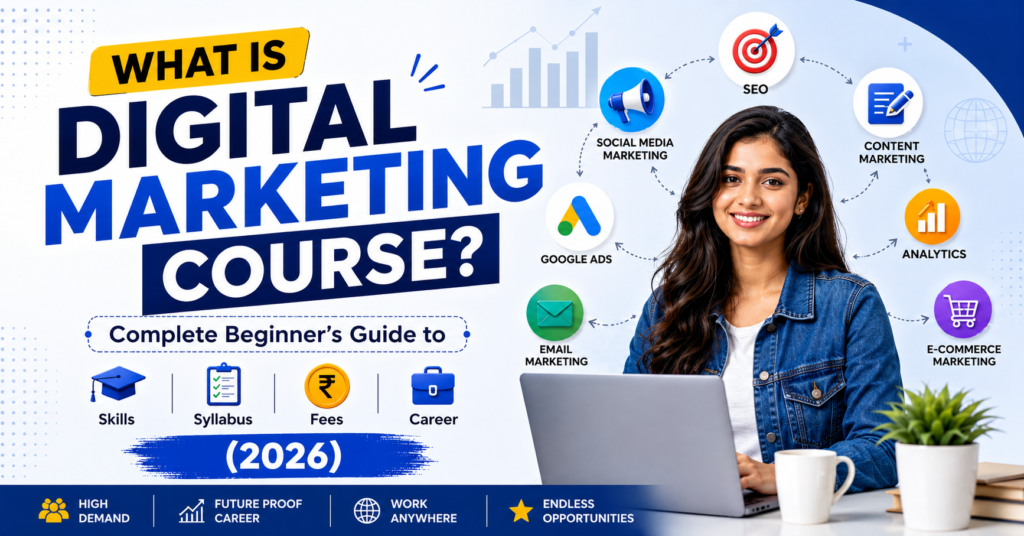
Introduction
In today’s digital world, almost every business uses the internet to attract customers, promote products, and increase sales. From small local shops to large multinational companies, everyone is investing in digital marketing. This has created a huge demand for skilled digital marketers across India and around the world.
If you are a student, job seeker, working professional, business owner, or someone planning a career switch, you may have heard people talking about digital marketing courses. One of the most common questions beginners ask is: What is digital marketing course?
A digital marketing course is a structured training program that teaches you how to market products and services using digital platforms such as Google, social media, websites, email, and online advertisements. It helps learners gain practical skills that are highly valued by employers and businesses.
The popularity of digital marketing has increased rapidly in India because companies are spending more on online advertising than ever before. As a result, people with digital marketing skills can find opportunities in agencies, startups, e-commerce companies, educational institutions, healthcare businesses, real estate firms, and many other industries.
In this complete beginner’s guide, you will learn:
What is digital marketing course and how it works
Who should join a digital marketing course
Eligibility requirements
Skills and syllabus covered
Course duration and fees
Career opportunities and salary
Best digital marketing institutes in Mumbai
How to choose the right course for your career goals
Whether you want to get a job, start freelancing, grow your business, or build an online career, this guide will help you understand everything you need to know before enrolling in a digital marketing course in 2026.
What Is a Digital Marketing Course?
What is digital marketing course? A digital marketing course is a training program designed to teach learners how to promote businesses, brands, products, and services through online channels.
Unlike traditional marketing, which focuses on newspapers, television, radio, and billboards, digital marketing uses internet-based platforms such as:
Google Search
YouTube
Websites
Online advertisements
Mobile apps
A good digital marketing course combines theoretical knowledge with practical training. Students learn not only the concepts but also how to use real digital marketing tools and platforms.
Simple Definition
Beginner Friendly
A digital marketing course is a professional training program that teaches you how to attract customers and grow a business online using search engines, social media, content, email, and paid advertising.
What Does a Digital Marketing Course Teach?
Most modern digital marketing courses cover:
SEO (Search Engine Optimization)
Google Ads
Social Media Marketing
Content Marketing
Email Marketing
Performance Marketing
Web Analytics
AI Tools for Marketing
Website Creation
How Is It Different from Traditional Marketing?
Traditional Marketing
Digital Marketing
Newspaper ads
Google Ads
TV commercials
YouTube ads
Radio promotions
Podcast & online audio ads
Billboards
Social media campaigns
Limited tracking
Detailed analytics
High advertising cost
Flexible budget options
Practical Learning Is the Biggest Advantage
One major benefit of a digital marketing course is that students work on real projects. For example, they may:
Create a website using WordPress
Run a Google Ads campaign
Design an Instagram marketing strategy
Perform keyword research
Write SEO-friendly blog content
Analyze website traffic using Google Analytics
This practical exposure helps beginners build confidence and become job-ready.
Common Tools Taught in Digital Marketing Courses
Google Analytics 4
Google Search Console
Google Ads
Meta Ads Manager
Canva
WordPress
SEMrush
Ahrefs
Mailchimp
Google Tag Manager
By the end of the course, learners understand how to plan, execute, and measure digital marketing campaigns effectively.
Why Learn Digital Marketing in 2026?
If you are wondering whether digital marketing is still a good career choice, the answer is yes. In fact, 2026 is one of the best times to learn digital marketing because businesses are becoming increasingly dependent on online channels.
- Rapid Growth of the Digital Economy
India has one of the world’s largest internet user bases. More people are shopping online, watching videos, using social media, and searching for products on Google. Businesses must reach these users digitally, which creates demand for digital marketers.
- AI Is Transforming Marketing
Modern digital marketing courses now include AI tools that help with:
Content creation
Keyword research
Ad optimization
Customer targeting
Marketing automation
Learning digital marketing in 2026 means learning how to work with AI-powered marketing tools.
- High Demand for Skilled Professionals
Companies are hiring for roles such as:
SEO Executive
Google Ads Specialist
Social Media Manager
Performance Marketer
Content Strategist
Email Marketing Specialist
Digital Marketing Manager
Many businesses struggle to find candidates with practical digital marketing skills.
- Freelancing Opportunities
Digital marketing is one of the most freelancer-friendly careers. After gaining experience, you can work with clients from different cities or countries.
Freelancers commonly offer services such as:
SEO
Social media management
Google Ads management
Content writing
Website optimization
- Remote Work Flexibility
Many digital marketing jobs can be performed remotely. This is especially attractive for:
Working professionals
Homemakers
Parents
People living outside metro cities
- Helpful for Entrepreneurs
Business owners can use digital marketing skills to:
Generate leads
Increase sales
Build brand awareness
Reduce dependency on third-party agencies
Improve customer engagement
- Strong Future Career Scope
As long as businesses use the internet to attract customers, digital marketing skills will remain valuable. The field continues to evolve with new platforms, technologies, and AI-driven strategies.
Why 2026 is a great time to start
Future-ready skill
Businesses are increasing digital ad spending.
AI tools are creating new job roles.
Freelancing and remote work opportunities are expanding.
Even small local businesses now need digital marketing support.
The skill is useful for jobs, business growth, and personal branding.
Who Should Join a Digital Marketing Course?
One of the best things about digital marketing is that it is suitable for people from almost any educational or professional background.
Students
College students can learn digital marketing alongside their studies and gain practical skills before graduation.
Fresh Graduates
Graduates often use digital marketing courses to improve employability and enter the job market faster.
Working Professionals
Professionals from sales, customer support, HR, operations, or other fields can switch to digital marketing careers.
Business Owners
Entrepreneurs can learn how to generate leads and grow their business online without relying completely on agencies.
Freelancers
Freelancers can offer digital marketing services to clients and build an independent income source.
Homemakers
Many homemakers choose digital marketing because it offers flexible learning and remote work opportunities.
Career Changers
If you are unhappy with your current career, digital marketing can provide a fresh start with strong growth potential.
Content Creators and Influencers
Understanding SEO, social media marketing, and analytics helps creators grow their audience more effectively.
Eligibility Criteria for a Digital Marketing Course
Another reason digital marketing is popular is that the entry requirements are generally simple.
Basic Eligibility
Easy entry
Requirement
Details
Education
10th, 12th, graduate, or postgraduate
Age
No strict age limit
Computer Skills
Basic knowledge is enough
Internet Usage
Basic familiarity required
English
Helpful but not mandatory
Coding Knowledge
Not required for beginners
Do You Need a Technical Background?
No. Students from commerce, arts, science, engineering, management, and other streams can learn digital marketing successfully.
Is Coding Required?
No. Basic digital marketing can be learned without coding. Some advanced SEO or analytics tasks may involve simple technical concepts, but beginners can start without any programming knowledge.
Important Qualities for Success
You do not need to be a tech expert. However, these qualities can help:
Willingness to learn
Creativity
Communication skills
Analytical thinking
Consistency
Curiosity about online trends
Types of Digital Marketing Courses
Now that you understand what is digital marketing course, the next question is: Which type of digital marketing course should you choose?
Today, there are hundreds of digital marketing courses available in India. Some are designed for beginners, while others are meant for experienced professionals. They also differ in duration, curriculum, teaching methods, certifications, and fees.
Choosing the right course depends on your career goals, learning style, budget, and available time.
Let’s explore the different types of digital marketing courses in detail.
- Certificate Digital Marketing Courses
Certificate courses are the most popular option for beginners. They are short-term training programs that focus on teaching practical digital marketing skills.
These courses usually cover the fundamentals of digital marketing, including SEO, Google Ads, social media marketing, content marketing, email marketing, and web analytics.
Best For
College students
Fresh graduates
Beginners
Freelancers
Small business owners
Course Duration
Typically ranges from 2 to 6 months, depending on the institute and learning mode.
Advantages
Affordable fees
Beginner-friendly curriculum
Practical assignments
Industry-recognized certifications
Faster job readiness
Limitations
May not cover advanced specialization topics in depth.
Quality varies across institutes, so it’s important to compare curriculum and faculty before enrolling.
- Diploma in Digital Marketing
Diploma programs provide more comprehensive training than short-term certificate courses. They usually include additional modules, live projects, internships, and placement assistance.
These programs are suitable for learners who want to build a strong foundation and prepare for full-time digital marketing roles.
Best For
Graduates
Career switchers
Working professionals
Job seekers
Course Duration
Generally 6 to 12 months.
What You’ll Learn
Advanced SEO
Performance Marketing
Marketing Automation
Google Analytics
AI in Digital Marketing
E-commerce Marketing
Client Projects
Benefits
In-depth learning
Better practical exposure
Portfolio development
Internship opportunities
Placement support in many institutes
- Advanced Digital Marketing Courses
Advanced courses are designed for professionals who already understand the basics and want to specialize.
Instead of covering introductory topics, these programs focus on strategy, campaign optimization, automation, and data-driven marketing.
Topics Covered
Advanced SEO
Technical SEO
Conversion Rate Optimization (CRO)
Performance Marketing
AI Marketing Tools
Marketing Automation
Advanced Google Analytics
Customer Journey Mapping
Best For
Experienced marketers
Agency professionals
Team leaders
Marketing managers
- Online Digital Marketing Courses
Online learning has become one of the most preferred ways to study digital marketing.
These courses allow students to learn from home through live classes or recorded video lessons.
Benefits
Learn from anywhere
Flexible schedule
Affordable pricing
Lifetime access (in many cases)
Suitable for working professionals
Ideal For
Homemakers
Students
Freelancers
Professionals with busy schedules
Things to Check Before Joining
Live doubt-solving sessions
Mentor support
Practical assignments
Placement assistance
Updated curriculum
Industry certifications
- Offline Classroom Digital Marketing Courses
Offline classroom training provides face-to-face interaction with trainers and fellow students.
Many learners prefer classroom learning because it offers structured guidance, networking opportunities, and immediate feedback.
Advantages
Interactive learning
Better classroom discussions
Personalized mentoring
Networking with peers
Hands-on workshops
Best For
Students who prefer classroom environments
Beginners who need regular guidance
Learners who benefit from direct interaction
- Self-Paced Digital Marketing Courses
Self-paced courses allow learners to study at their own speed using recorded videos, downloadable resources, and assignments.
There are no fixed schedules, making them ideal for people with unpredictable routines.
Suitable For
Full-time employees
Entrepreneurs
Parents
Busy professionals
Advantages
Learn anytime
Flexible pace
Lower cost
Access to recordings
Limitation
Requires self-discipline and consistent practice.
- Digital Marketing Degree Programs
Some universities now offer undergraduate and postgraduate programs with digital marketing as a specialization.
These programs combine traditional marketing concepts with digital marketing strategies.
Suitable For
Students planning long-term academic careers
Learners who prefer formal education
Duration
Bachelor’s Degree: 3–4 years
Master’s Degree: 2 years
Comparison of Different Types of Digital Marketing Courses
Course Type Duration Best For Key Benefit
Certificate Course 2–6 Months Beginners Quick job-ready skills
Diploma Course 6–12 Months Graduates Comprehensive practical training
Advanced Course 3–6 Months Professionals Specialization and career growth
Online Course Flexible Working professionals Learn from anywhere
Offline Course Fixed Schedule Students Classroom interaction
Self-Paced Course Flexible Busy learners Learn at your own speed
Degree Program 2–4 Years Students Formal academic qualification
Complete Digital Marketing Course Syllabus
One of the biggest reasons people search for “What is digital marketing course” is to understand what they’ll actually learn.
A high-quality digital marketing course goes beyond theory. It provides hands-on training, live projects, case studies, and exposure to industry-standard tools. The exact syllabus may vary by institute, but most comprehensive programs include the following modules.
- Digital Marketing Fundamentals
This introductory module explains the basics of digital marketing, including how businesses use online channels to attract customers.
You will learn:
What is digital marketing?
Digital marketing vs traditional marketing
Marketing funnel
Customer journey
Digital marketing channels
Latest industry trends
- Website Planning and Creation
Every digital marketing campaign starts with a website.
In this module, you’ll learn how websites are planned, created, and optimized for both users and search engines.
Topics include:
Domain and hosting
Website structure
Landing pages
User experience (UX)
Mobile responsiveness
- WordPress Website Development
WordPress powers millions of websites worldwide, making it one of the most valuable skills for beginners.
You’ll learn:
Installing WordPress
Choosing themes
Plugins
Creating pages
Blog management
Website security
Basic website optimization
- Search Engine Optimization (SEO)
SEO is one of the most important modules in any digital marketing course.
It teaches you how to improve a website’s visibility in search engine results without paying for advertisements.
Key topics include:
Keyword research
On-page SEO
Off-page SEO
Technical SEO
Local SEO
Link building
SEO audits
Content optimization
- Content Marketing
Content is the foundation of digital marketing.
This module teaches you how to create valuable content that attracts, educates, and converts potential customers.
Topics covered:
Content strategy
Blog writing
SEO content writing
Copywriting basics
Content calendar
Storytelling
AI-assisted content creation
- Social Media Marketing (SMM)
Social media platforms play a major role in brand awareness and customer engagement.
You’ll learn how to create and manage campaigns on platforms such as:
Facebook
Instagram
LinkedIn
YouTube
X (formerly Twitter)
Pinterest
Skills include:
Content planning
Audience targeting
Organic growth
Paid promotions
Community management
- Google Ads (Pay-Per-Click Advertising)
Google Ads helps businesses appear at the top of search results through paid advertising.
You’ll learn:
Search campaigns
Display campaigns
Video campaigns
Shopping ads
Keyword bidding
Ad copy creation
Campaign optimization
- Meta Ads
This module focuses on advertising across Facebook and Instagram.
Topics include:
Campaign setup
Audience targeting
Budget management
Creative design
Retargeting
Performance analysis
- Email Marketing
Email marketing remains one of the most effective channels for customer communication.
You’ll learn:
Email campaign creation
Newsletter design
Automation workflows
Lead nurturing
Email performance tracking
- Web Analytics
Measuring campaign performance is a critical digital marketing skill.
You’ll understand how to analyze user behavior and make data-driven decisions using tools such as Google Analytics 4.
Topics include:
Traffic analysis
User engagement
Conversion tracking
Goal setup
Reports and dashboards
- AI Tools for Digital Marketing
Modern digital marketing courses now include AI-powered tools that improve productivity and campaign performance.
You may learn how to use AI for:
Content generation
Keyword research
Image creation
Ad copy ideas
Data analysis
Workflow automation
The focus should always be on using AI responsibly to enhance human creativity and decision-making.
- Freelancing and Portfolio Building
Many institutes also teach learners how to build a professional portfolio and start working independently.
Topics may include:
Creating a personal brand
Building a portfolio website
Finding freelance clients
Proposal writing
Client communication
Pricing digital marketing services
Skills You’ll Learn in a Digital Marketing Course
A digital marketing course doesn’t just teach tools—it helps you develop a combination of technical, analytical, and communication skills that employers value.
Technical Skills
By the end of a comprehensive course, you can expect to learn:
Search Engine Optimization (SEO)
Search Engine Marketing (SEM)
Google Ads campaign management
Meta Ads management
Social Media Marketing
Content Marketing
Email Marketing
Website management
Google Analytics
Keyword research
Marketing automation basics
AI-assisted marketing workflows
Soft Skills
Equally important are the professional skills you’ll build:
Communication
Creativity
Problem-solving
Critical thinking
Time management
Team collaboration
Data interpretation
Presentation skills
Client handling
These skills are transferable and useful across many industries.
Digital Marketing Course Duration
One of the most common questions beginners ask after understanding what is digital marketing course is:
“How long does it take to complete a digital marketing course?”
The answer depends on several factors, such as the type of course, your learning goals, whether you choose online or offline training, and the depth of the curriculum.
Some learners only want to understand the basics, while others want to become job-ready with practical experience. Therefore, digital marketing courses are available in different durations to suit different needs.
Let’s understand each option in detail.
- Short-Term Digital Marketing Courses (1–2 Months)
Short-term courses are designed to introduce learners to the fundamentals of digital marketing.
These courses generally focus on the basics of:
Introduction to Digital Marketing
SEO Basics
Social Media Marketing
Google Ads Overview
Content Marketing
Email Marketing
Best For
Beginners exploring digital marketing
Business owners
Students looking for basic knowledge
Professionals wanting to understand online marketing
Advantages
Affordable
Quick learning
Good introduction to the field
Limitations
Since the duration is short, these courses usually do not provide in-depth practical training or advanced modules.
- Three to Four-Month Digital Marketing Courses
This is one of the most popular course durations in India.
A 3 to 4-month course generally covers all major digital marketing modules along with practical assignments and projects.
Students usually learn:
SEO
Google Ads
Meta Ads
Social Media Marketing
Email Marketing
WordPress
Analytics
AI Tools
Blogging
Best For
College students
Fresh graduates
Career switchers
Freelancers
Outcome
By the end of the course, learners can usually apply for entry-level digital marketing jobs or begin freelancing with basic confidence.
- Six-Month Advanced Digital Marketing Courses
A six-month course offers more practical exposure and advanced concepts.
Apart from learning the core modules, students often work on:
Live client projects
Website development
Advanced SEO
Performance Marketing
Marketing Automation
Portfolio building
Internship programs
Best For
Job seekers
Working professionals
Entrepreneurs
Anyone seeking comprehensive practical training
Advantages
Better understanding of tools
Stronger portfolio
More confidence in handling real projects
Higher employability
- One-Year Diploma Programs
Some institutes offer one-year diploma programs that provide extensive training in digital marketing.
These programs include:
Advanced specialization
Industry certifications
Capstone projects
Internship
Placement assistance
Soft skills training
Interview preparation
Best For
Students looking for an in-depth learning experience before entering the job market.
- Degree Programs
Universities also offer undergraduate and postgraduate programs that include digital marketing as part of their curriculum.
Although these programs provide strong academic knowledge, many students still choose additional certification courses to gain practical exposure.
Which Course Duration Should You Choose?
Learner Profile Recommended Duration
Beginner 2–4 Months
College Student 3–6 Months
Fresh Graduate 4–6 Months
Working Professional Weekend or Online 3–6 Months
Business Owner 1–3 Months
Career Switcher 4–6 Months
Freelancer 3–6 Months
Pro Tip
Instead of choosing a course based solely on duration, evaluate how much practical learning it offers. A shorter course with live projects and mentorship can often be more valuable than a longer course focused mainly on theory.
Digital Marketing Course Fees in India
After learning what is digital marketing course and understanding its duration, the next important consideration is the cost.
One of the biggest advantages of digital marketing education is that there are courses available for almost every budget. Whether you’re a student looking for an affordable option or a professional seeking advanced training, you’ll find a course that matches your needs.
However, remember that the cheapest course is not always the best. A higher-quality course with experienced trainers, practical projects, and placement support often provides much better long-term value.
Average Digital Marketing Course Fees in India (2026)
Course Type Approximate Fee Range
Free Introductory Courses ₹0
Basic Certificate Course ₹10,000 – ₹25,000
Professional Certification ₹25,000 – ₹60,000
Advanced Digital Marketing Course ₹50,000 – ₹1,20,000
Diploma Program ₹60,000 – ₹2,00,000+
Degree Programs Varies by university
Note: Fees vary depending on the institute, curriculum, faculty experience, duration, certifications, internship opportunities, and placement assistance.
Factors That Affect Course Fees
When comparing digital marketing courses, don’t look at the fee alone. Consider what you’re getting in return.
- Curriculum
A well-designed curriculum should include:
SEO
Google Ads
Meta Ads
Social Media Marketing
Content Marketing
Email Marketing
Google Analytics
AI tools
Marketing Automation
Freelancing
Portfolio Building
Courses that are regularly updated to reflect current industry trends generally offer better value.
- Trainer Experience
Learning from experienced industry professionals can make a significant difference.
Look for trainers who have:
Worked on real campaigns
Managed client projects
Practical industry experience
Up-to-date knowledge of AI and digital marketing trends
- Practical Training
Theoretical knowledge alone is not enough.
A good digital marketing course should include:
Live projects
Case studies
Campaign creation
Website development
Practical assignments
Portfolio creation
Hands-on experience helps learners become job-ready.
- Internship Opportunities
Some institutes offer internships that allow students to apply what they’ve learned in real business environments.
An internship can help you:
Build confidence
Understand client expectations
Strengthen your resume
Gain practical experience
- Placement Assistance
Many learners enroll in digital marketing courses to secure a job.
Before joining, check whether the institute provides:
Resume building
Mock interviews
Placement support
Employer connections
Career guidance
- Industry Certifications
Courses that prepare you for recognized certifications can enhance your resume and demonstrate your skills to employers.
Is an Expensive Course Always Better?
Not necessarily.
A higher fee doesn’t automatically mean better training. Instead, compare institutes based on:
Updated curriculum
Practical learning
Faculty expertise
Student reviews
Placement support
Industry exposure
The best course is one that helps you build real skills and confidence—not just collect certificates.
Online vs Offline Digital Marketing Courses
One of the most common dilemmas for learners is choosing between an online course and classroom training.
Both options have their strengths. The right choice depends on your schedule, learning style, location, and career goals.
Comparison: Online vs Offline Digital Marketing Courses
Feature Online Course Offline Classroom
Flexibility Learn anytime Fixed schedule
Travel Not required Required
Cost Usually lower Often higher
Interaction Virtual Face-to-face
Networking Limited Better opportunities
Learning Pace Self-paced or live Structured
Recordings Often available May not be available
Practical Sessions Available online Hands-on classroom support
Best For Working professionals, students in remote areas Beginners who prefer direct guidance
Advantages of Online Courses
Online learning has become increasingly popular because it offers flexibility.
Benefits include:
Learn from home
Save travel time
Access recorded sessions
Affordable fees
Suitable for busy professionals
Easy access to updated learning materials
Advantages of Offline Courses
Classroom learning remains a preferred choice for many beginners.
Benefits include:
Immediate doubt-solving
Better classroom interaction
Networking opportunities
Personalized mentoring
Practical workshops
Greater learning discipline
Which Option Is Better?
There is no universal answer.
Choose online learning if you:
Are a working professional
Live outside major cities
Prefer flexible schedules
Need recorded sessions
Choose offline learning if you:
Learn better in a classroom environment
Need regular motivation
Want face-to-face mentoring
Prefer structured learning
The most important factor isn’t whether the course is online or offline—it’s whether it provides practical training, experienced mentors, live projects, and career support.
Certifications You Can Earn
Completing a digital marketing course often gives you access to valuable certifications that can strengthen your resume and demonstrate your skills to employers.
A certificate alone won’t guarantee a job, but when combined with practical experience and a strong portfolio, it can improve your credibility.
Some well-recognized certifications include:
Google Digital Marketing Certifications
Google Ads Certifications
Google Analytics Certification
HubSpot Content Marketing Certification
HubSpot Email Marketing Certification
Meta Certified Digital Marketing Associate
Semrush Academy Certifications
LinkedIn Learning Certificates
Why Certifications Matter
Certifications can help you:
Showcase your knowledge
Improve your resume
Build employer confidence
Stay updated with industry practices
Validate your commitment to continuous learning
However, employers increasingly value practical skills over certificates alone. Focus on building real projects, a portfolio, and measurable results alongside your certifications.
Career Opportunities After Completing a Digital Marketing Course
After understanding what is digital marketing course, the next question most learners ask is:
“What kind of job can I get after completing a digital marketing course?”
The good news is that digital marketing is one of the few career fields where your skills, practical experience, and portfolio often matter more than your academic background.
Whether you’re a student, graduate, career switcher, freelancer, or entrepreneur, there are numerous opportunities available once you develop the right skills.
Let’s explore the most popular career options.
1. Digital Marketing Executive
A Digital Marketing Executive is responsible for planning and executing online marketing campaigns to help businesses increase their online presence and generate leads.
Key Responsibilities
- Managing digital campaigns
- Website updates
- SEO implementation
- Social media management
- Campaign reporting
- Lead generation
Best For
Freshers beginning their digital marketing careers.
2. SEO Executive
SEO (Search Engine Optimization) professionals help websites rank higher on Google search results.
Responsibilities
- Keyword research
- On-page SEO
- Technical SEO
- Link building
- Content optimization
- SEO audits
Skills Required
- Keyword Research
- Google Search Console
- Google Analytics
- SEO Tools
- Content Optimization
3. PPC / Google Ads Specialist
These professionals manage paid advertising campaigns on Google.
Responsibilities
- Campaign setup
- Keyword bidding
- Budget management
- Ad optimization
- Conversion tracking
4. Social Media Marketing Executive
Businesses actively use platforms like Instagram, Facebook, LinkedIn, and YouTube to connect with customers.
Social Media Executives create engaging content, manage communities, and grow brand visibility.
Responsibilities
- Content planning
- Social media strategy
- Scheduling posts
- Community management
- Performance tracking
5. Content Marketing Specialist
Content marketers create blogs, website content, ebooks, newsletters, and other valuable content that attracts potential customers.
Responsibilities
- Blog writing
- Content strategy
- SEO writing
- Copywriting
- Content calendars
6. Email Marketing Specialist
Email marketing remains one of the highest ROI marketing channels.
Responsibilities include:
- Newsletter campaigns
- Automation
- Lead nurturing
- Email analytics
- Customer engagement
7. Performance Marketing Specialist
Performance marketers focus on measurable business results.
They optimize campaigns to maximize:
- Leads
- Sales
- Return on Ad Spend (ROAS)
- Conversion rates
8. Web Analytics Specialist
Analytics professionals study website data to improve marketing performance.
They use tools like:
- Google Analytics 4
- Google Tag Manager
- Search Console
- Looker Studio
9. Digital Marketing Manager
After gaining several years of experience, professionals can move into managerial roles.
Responsibilities include:
- Team management
- Campaign planning
- Budget allocation
- Client communication
- Marketing strategy
- Business growth
10. Freelance Digital Marketer
Freelancing is becoming increasingly popular because it offers flexibility and the opportunity to work with multiple clients.
Freelancers commonly provide services such as:
- SEO
- Google Ads
- Meta Ads
- Social Media Marketing
- Content Writing
- Website Management
- Email Marketing
Many freelancers eventually establish their own agencies or consulting businesses.
11. Digital Marketing Consultant
Consultants advise businesses on improving their online marketing strategies.
They typically work with startups, SMEs, and established brands to:
- Develop marketing plans
- Increase website traffic
- Improve conversions
- Optimize advertising budgets
12. Entrepreneur
One of the biggest advantages of learning digital marketing is that you can apply these skills to your own business.
Business owners use digital marketing to:
- Generate leads
- Increase online sales
- Build a personal brand
- Reach a larger audience
- Reduce advertising costs over time
Digital Marketing Salary in India (2026)
One of the biggest reasons people search for what is digital marketing course is to understand the earning potential after completing the course.
While salaries vary depending on skills, location, company size, and experience, digital marketing offers competitive career growth compared to many traditional professions.
Average Salary by Experience
| Experience | Approximate Annual Salary |
|---|---|
| Fresher (0–1 Year) | ₹2.5 – ₹4.5 LPA |
| 1–3 Years | ₹4 – ₹7 LPA |
| 3–5 Years | ₹7 – ₹12 LPA |
| 5–8 Years | ₹12 – ₹20 LPA |
| Digital Marketing Manager | ₹10 – ₹25+ LPA |
| Freelancer | Depends on projects and clients |
| Consultant | Varies based on expertise |
Note: These figures are approximate and can vary based on location, company, specialization, and market conditions.
Factors That Influence Salary
Your income depends on several factors, including:
- Skills and practical experience
- Certifications
- Portfolio quality
- Communication skills
- Location
- Industry
- Specialization
- Ability to generate measurable business results
Professionals specializing in SEO, Performance Marketing, Analytics, and Marketing Automation often command higher salaries due to their specialized expertise.
Industries Hiring Digital Marketers
One of the greatest strengths of digital marketing is that it is relevant across almost every industry.
Here are some sectors that actively hire digital marketing professionals:
E-commerce
Online retailers rely heavily on digital marketing for customer acquisition and retention.
Education
Schools, colleges, universities, and EdTech companies use digital marketing to attract prospective students and promote courses.
Healthcare
Hospitals, clinics, diagnostic centers, and healthcare providers use online marketing to build trust and connect with patients.
Real Estate
Builders and real estate consultants use digital marketing for lead generation, virtual tours, and property promotions.
Finance
Banks, insurance companies, fintech startups, and investment firms require digital marketers to educate and engage customers.
Travel & Hospitality
Travel agencies, hotels, tour operators, and airlines depend on digital campaigns to reach travelers.
SaaS & Technology
Software companies use content marketing, SEO, paid advertising, and email marketing to generate qualified leads.
Retail
Retail brands leverage digital marketing to increase both online and in-store sales.
Media & Entertainment
Media houses, production companies, influencers, and content creators all use digital platforms to grow their audiences.
Startups
Startups often prioritize digital marketing because it provides measurable results and scalable customer acquisition.
How to Choose the Best Digital Marketing Course
After understanding what is digital marketing course, choosing the right institute becomes one of the most important decisions.
With so many institutes offering similar promises, it is essential to evaluate them based on objective criteria.
Checklist Before Enrolling
Updated Curriculum
Ensure the course covers:
- SEO
- Google Ads
- Meta Ads
- Content Marketing
- AI Tools
- Marketing Automation
- Google Analytics 4
Practical Learning
A good course should include:
- Live projects
- Case studies
- Website development
- Campaign creation
- Portfolio building
Experienced Trainers
Learn from professionals with real industry experience rather than trainers who rely solely on theory.
Certifications
Check whether the institute prepares students for recognized industry certifications.
Placement Assistance
Look for support such as:
- Resume building
- Mock interviews
- Job referrals
- Placement drives
Student Reviews
Read genuine reviews and, if possible, speak to alumni to understand their learning experience.
Internship Opportunities
Internships help bridge the gap between classroom learning and real-world work.
AI-Integrated Learning
As AI continues to reshape digital marketing, choose a course that introduces learners to AI-powered tools and ethical AI usage.
Best Digital Marketing Institutes in Mumbai
Mumbai is one of India’s leading business hubs, offering a wide range of digital marketing training options. When choosing an institute, look beyond marketing claims and evaluate factors such as curriculum, trainer expertise, practical exposure, certifications, internships, placement support, and student outcomes.
Below are three well-known institutes that learners often consider.
1. DGMark Institute
DGMark Institute is known for its practical approach to digital marketing education. Its programs are designed to help beginners, students, entrepreneurs, freelancers, and career switchers build industry-relevant skills.
Highlights
- Beginner-friendly curriculum
- SEO, Google Ads, Meta Ads, Social Media Marketing, Content Marketing, and AI-focused modules
- Hands-on projects and practical assignments
- Portfolio-building support
- Internship and placement assistance (subject to institute policies)
- Multiple learning options for different schedules
Best For
- Students
- Fresh graduates
- Career switchers
- Small business owners
- Freelancers
Why Consider It: Learners looking for practical training and guided mentorship may find DGMark Institute suitable for building foundational digital marketing skills.
2. IIM Mumbai
IIM Mumbai offers executive education and management-focused programs that may include digital marketing and related subjects as part of broader business education.
Highlights
- Strong academic reputation
- Management-oriented learning
- Suitable for professionals and business leaders
- Strategic marketing perspective
Best For
- Working professionals
- Managers
- Entrepreneurs
- Business leaders seeking executive education
Why Consider It: If you’re looking to combine digital marketing with strategic management concepts, executive programs from IIM Mumbai may be worth exploring.
3. Boston Institute
Boston Institute offers digital marketing training with a focus on practical learning and industry-relevant skills.
Highlights
- Comprehensive curriculum
- Practical assignments
- Industry certifications
- Placement support (as per institute offerings)
- Classroom and learning support
Best For
- Beginners
- Students
- Job seekers
- Professionals looking to upskill
Why Consider It: Learners seeking structured training with practical exposure can compare Boston Institute’s curriculum, faculty, and career support with other available options.
How to Compare Institutes
Before making your final decision, compare institutes using the following criteria:
| Evaluation Criteria | What to Look For |
|---|---|
| Curriculum | Updated modules covering SEO, Ads, AI, Analytics, and Automation |
| Trainers | Experienced industry professionals |
| Practical Exposure | Live projects, assignments, and case studies |
| Certifications | Industry-recognized credentials |
| Internship | Opportunities to gain hands-on experience |
| Placement Support | Resume guidance, interview preparation, and job assistance |
| Student Reviews | Feedback from alumni and independent review platforms |
| Learning Format | Online, offline, or hybrid options |
Remember, the best institute is the one that aligns with your learning style, career goals, and budget while providing meaningful practical experience.
Common Mistakes Beginners Should Avoid
Many learners make avoidable mistakes when selecting or completing a digital marketing course. Being aware of these pitfalls can help you make better decisions.
Choosing a Course Only Because It’s Cheap
Low fees should not be the only deciding factor. Focus on curriculum quality, practical exposure, and trainer expertise.
Ignoring Practical Experience
Watching videos alone is not enough. Build websites, run campaigns, write blog posts, and analyze real data to strengthen your skills.
Expecting Instant Results
Digital marketing is a skill that develops over time. Consistent practice and continuous learning are essential.
Not Building a Portfolio
A portfolio showcasing your projects can make a stronger impression than certificates alone.
Ignoring Analytics
Successful marketers use data to make decisions. Learn how to measure performance using analytics tools.
Avoiding AI Tools
AI is becoming an integral part of digital marketing. Familiarity with AI-powered tools can improve productivity and support better campaign planning.
Stopping Learning After the Course
Digital marketing evolves rapidly. Follow industry blogs, attend webinars, experiment with new tools, and continue upgrading your skills.
Frequently Asked Questions (FAQs)
1. What is a digital marketing course?
A digital marketing course is a training program that teaches learners how to promote businesses, products, and services using online channels such as search engines, social media, websites, email, and paid advertising.
2. Who can join a digital marketing course?
Students, graduates, working professionals, entrepreneurs, freelancers, homemakers, and career switchers can all join a digital marketing course.
3. Is coding required to learn digital marketing?
No. Most beginner-level digital marketing courses do not require coding knowledge.
4. What is the average duration of a digital marketing course?
Depending on the program, the duration typically ranges from 2 to 6 months for certificate courses, while diploma and degree programs may take longer.
5. How much does a digital marketing course cost in India?
Course fees vary widely based on the institute, curriculum, and duration. Short-term certificate courses are generally more affordable than advanced diploma or degree programs.
6. Can I learn digital marketing online?
Yes. Many reputable institutes offer online courses with live sessions, recorded lectures, practical assignments, and mentor support.
7. Is digital marketing a good career in 2026?
Yes. Digital marketing continues to be a high-demand field as businesses increasingly invest in online channels to reach customers.
8. What salary can a fresher expect after completing a digital marketing course?
Entry-level salaries vary by company, location, and skills, but freshers with practical experience and a strong portfolio often have better employment prospects.
9. Which skills are most important in digital marketing?
Some of the most valuable skills include SEO, Google Ads, social media marketing, content marketing, analytics, communication, and data interpretation.
10. How do I choose the best digital marketing course?
Compare institutes based on curriculum, trainer expertise, practical learning, certifications, internships, placement support, and student reviews rather than choosing solely on fees.
Conclusion
If you’ve been wondering what is digital marketing course, this guide has covered everything you need to know—from its meaning and syllabus to course duration, fees, career opportunities, salary expectations, and how to choose the right institute.
A digital marketing course is more than just a certification. It is an opportunity to develop practical skills that businesses actively seek in today’s digital-first economy. Whether your goal is to secure a job, switch careers, grow your business, or build a freelance career, learning digital marketing can open doors to a wide range of opportunities.
When selecting a course, prioritize practical training, experienced mentors, an updated curriculum, AI-integrated learning, live projects, internships, and placement support. These factors will contribute more to your long-term success than the course fee or the duration alone.
Finally, remember that success in digital marketing doesn’t come from completing a course alone. It comes from continuously learning, experimenting, building a portfolio, staying updated with industry trends, and applying your knowledge to real-world projects.
With dedication and consistent practice, a digital marketing course can become the foundation of a rewarding and future-ready career. Best of luck on your digital marketing journey!